
chemical analysis instruments
How to Choose Chemical Analysis Instruments for Laboratory and Process Measurement
Start with the result and operating environment you need
Choosing an analytical instrument starts with the result you need, not with a familiar product category. Define whether you need to identify an unknown compound, quantify a known analyte, classify samples, monitor a changing process, or detect a trace gas. Then describe the material and operating environment that will produce the measurement.
A useful first brief includes:
- Analyte: the compound, class of compounds, gas, particle, or broader chemical feature you need to observe.
- Measurement purpose: identification, classification, quantitation, or process control.
- Expected concentration range: include the lowest and highest values you expect, rather than only a nominal target.
- Sample route: a prepared laboratory sample, a nearby process sample, a process stream, or a gas path.
- Required response: a result for occasional decisions, a fast result during an experiment, or continuous information during production.
- Operating conditions: temperature, pressure, solids, flow, matrix complexity, and any exposure that could affect the measurement path.
This order prevents a common selection error: choosing an instrument because its specification appears impressive before checking whether its measurement principle matches the analyte and sample. Method sensitivity must be judged against the amount and concentration available in the sample. A method that can detect a signal in one matrix may not answer the same question in another.
Your shortlist should therefore contain a measurement route and a reason for that route. If you cannot state what result the instrument must produce, which material it will encounter, and how quickly the result must arrive, the shortlist is not ready for supplier comparison.
The central decision is a fit question: which measurement principle and measurement location can produce the required result under your actual conditions? Process analytical technology guidance treats tool selection as part of understanding the process and materials, including the measurement method and the tool location. Comparisons between online and laboratory measurement also call for attention to parameter criticality, analytical complexity, production mode, regulatory constraints, and total economics.
Use those criteria before comparing brands. A laboratory method may provide the preparation and instrument access needed for a difficult analysis. A process measurement may justify a different arrangement when timing or process exposure governs the decision. Neither route is automatically suitable for every chemical question.
Separate instrument category from measurement mode
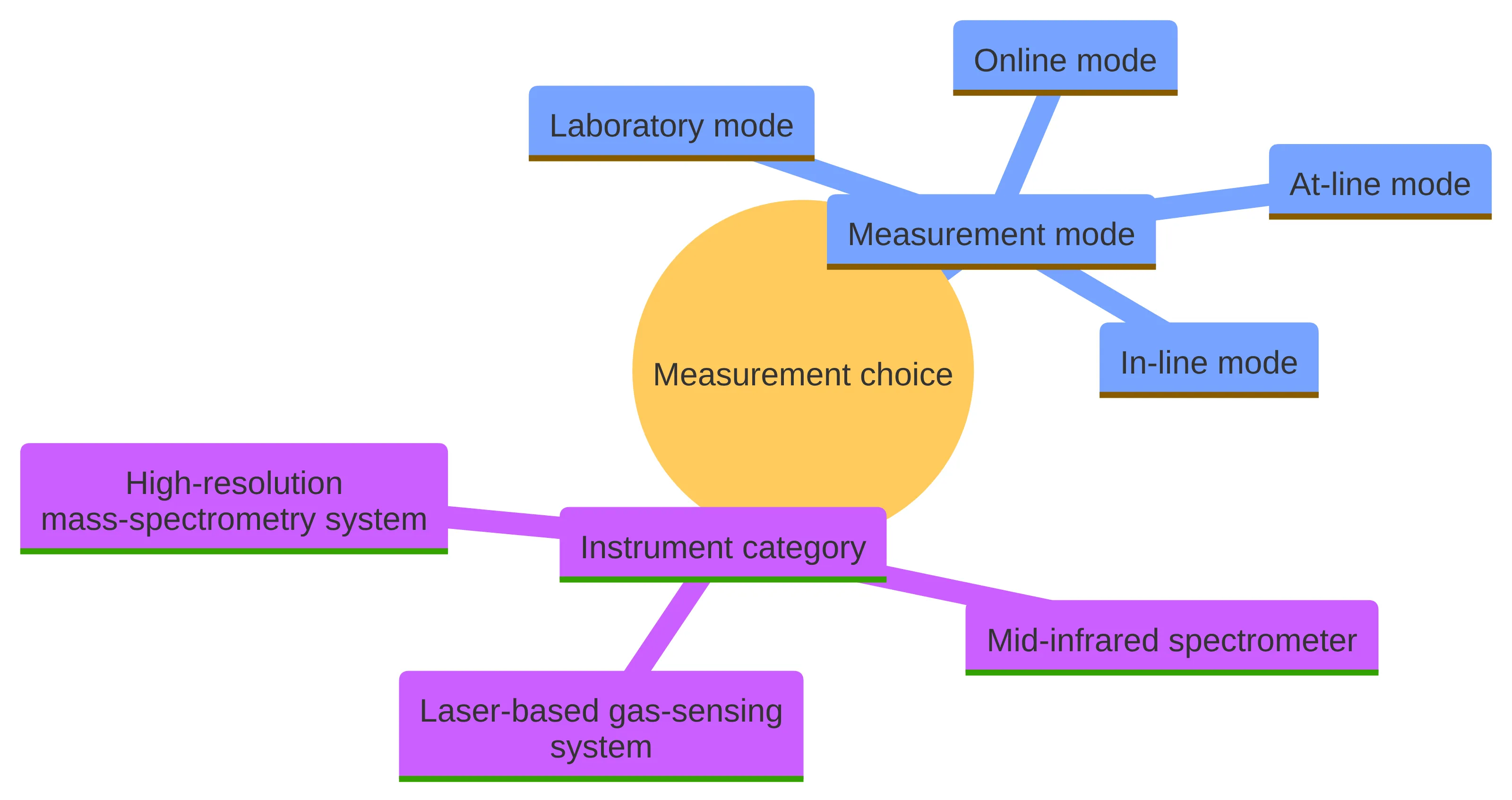
Instrument category and measurement mode answer different questions. The category describes how the instrument obtains chemical information; the mode describes where and how the sample reaches that instrument.
For the supported options in this guide, the category may be a mid-infrared spectrometer or a laser-based gas-sensing system. These categories do not answer identical analytical questions. Mid-infrared work depends on matching the wavelength range to the target analytes and resolving relevant spectral features. Laser gas sensing can target a gas absorption feature or use an optical arrangement that increases interaction with the gas.
The mode may then be laboratory, at-line, online, or in-line:
- Laboratory mode brings a sample to a separate analytical setting, where preparation and more complex instrumentation may be possible.
- At-line mode collects and analyzes a sample close to the process.
- Online mode analyzes a process sample and may return it to the process or discard it.
- In-line mode monitors the process without removing a sample from the process flow.
Keeping these dimensions separate makes comparison more precise. You might need spectroscopy in a laboratory for one experiment and an in-line spectroscopic arrangement for a continuous process. The instrument category has not changed, but the interface, sampling burden, calibration approach, and operating exposure have.
Ask two questions in sequence:
- What signal can answer the chemical question? Consider absorption features, mass-to-charge information, or another supported measurement principle that relates to the analyte.
- Where must that signal be measured? Decide whether the sample can be removed, whether preparation is acceptable, and whether the result must follow a changing process.
This sequence avoids treating an instrument’s physical form as proof of suitability. It also keeps a portable, laboratory, or process-mounted arrangement from being treated as a separate analytical principle when it is primarily a different measurement mode. Your shortlist should name both dimensions, such as “mid-infrared spectroscopy for an at-line liquid sample” or “laser gas sensing in a controlled process gas path,” only after the analyte and conditions support that description.
To make the comparison auditable, keep category and mode in separate fields in the same shortlist record. Add the analyte, intended result, concentration range, matrix, response requirement, sample interface, and evidence status beside them. This shows whether a proposed change solves the chemical problem or merely changes where the measurement occurs. It also exposes missing information early: a plausible category without a workable sample route is not yet a complete option, while a workable route without evidence across the intended range remains an evaluation item.
Use analyte and concentration range to narrow the shortlist
Analyte identity and concentration range should narrow the shortlist before speed or convenience enters the discussion. A qualitative identification task has a different success condition from quantitative control.
Write the concentration problem as a range, not a single number. Record:
- the expected minimum and maximum concentration;
- whether the target is a major component, a minor component, or a trace constituent;
- the available sample amount and volume;
- whether other compounds may overlap with the target signal;
- whether the result must distinguish presence, identity, concentration, or change over time.
A validated quantitative method should show detector response that is linear across the anticipated analyte range. Treat that value as part of the described validation approach, not as a universal guarantee for every instrument or matrix.
Use the concentration range to remove unsuitable options, then ask how the supplier will demonstrate the remaining option across your actual range. If your expected range is wide, ask whether the proposed method maintains a usable response throughout it or requires separate configurations, dilution, or calibration regions.
Compare laboratory, at-line, online, and in-line measurement
Measurement mode determines how much of the process is exposed to sampling and how quickly information can return to the decision point. The distinctions below describe the sample route; they do not rank the modes.
| Measurement mode | Sample route | Where it can help | Questions to resolve |
|---|---|---|---|
| Laboratory | A sample is removed and transported to a separate analytical setting. | Complex preparation or high-resolution instrumentation may be practical. | Will transport, storage, preparation, and elapsed time change the result or delay the decision? |
| At-line | A sample is collected and analyzed close to the process. | The measurement remains near the process while retaining a separate sample step. | How representative is the nearby sample, and how much handling is required? |
| Online | A process sample is analyzed and may be returned to the process or discarded. | The sample can reach the analyzer without requiring every measurement to occur directly in the main flow. | What sample conditioning, routing, disposal, or return conditions are required? |
| In-line | The process is monitored without removing a sample from the process flow. | Continuous information can be obtained within the process stream. | Can the instrument interface tolerate the process while producing a result you can interpret? |
At-line, online, and in-line therefore differ by sample collection and location, not merely by the label used for the instrument. Inline particle monitoring, for example, analyzes particles continuously in the process stream, whereas offline monitoring requires manual sampling and transport to a separate laboratory. Offline arrangements can support more complex preparation and high-resolution instruments, while some of those instruments may not suit harsh production environments.
Choose the mode by matching timing and analytical burden. Compare these factors before deciding:
- Parameter criticality: a parameter that directly affects a quality or safety decision may require more immediate monitoring than a parameter used for periodic characterization.
- Analytical complexity: a difficult method may require preparation or conditions that are easier to maintain in a laboratory.
- Production volume and mode: continuous or high-volume operation can create a different information need from occasional or low-volume work.
- Regulatory constraints: required laboratory analyses or site procedures may limit which process measurement can replace or supplement them.
- Total economics: include initial equipment, recurring laboratory work, sampling labor, conditioning, maintenance, and integration.
The direct action is to write a mode decision beside each shortlisted method. State why the sample can be removed, must stay near the process, or must remain in the process stream. If the reason is only that a mode sounds faster or more modern, return to the analytical question.
Use a two-stage comparison to keep that decision disciplined. First eliminate arrangements that cannot meet the required timing, sample route, or operating conditions. Then compare the remaining methods on analytical complexity, parameter criticality, regulatory constraints, and total economics. If a process arrangement offers timely information but a laboratory arrangement supports more complex preparation or higher-resolution instrumentation, record both roles rather than forcing one mode to answer every question. The shortlist can then distinguish a process-monitoring signal from the separate analytical work needed to characterize or verify a sample.
Balance response time against analytical complexity and process exposure
Response time matters when the measured condition changes faster than a delayed result can support the decision. It should not be treated as a substitute for selectivity, concentration range, calibration, or sample compatibility.
Laser gas-sensing approaches illustrate why the response requirement must be stated precisely. A tunable diode laser absorption spectroscopy arrangement scans a tunable laser across a gas absorption feature to quantify concentration; the cited overview lists ppb-to-ppm sensitivity and a response time below one second. Cavity-enhanced absorption and ring-down spectroscopy are described as extending the optical path to several kilometers and reaching sensitivity down to parts-per-trillion levels. Quantum-cascade-laser photoacoustic spectroscopy has also been investigated for sensitive and selective trace-gas detection at ppb and sub-ppb concentrations.
These descriptions identify technical routes, not a universal outcome. Gas composition, pressure, temperature, optical path, interferents, sampling, and calibration can determine whether a particular arrangement answers your question.
Use a response-time brief that includes the reason for the timing requirement:
- State how often the process or experiment changes in a way that affects the measured parameter.
- State the latest useful time for receiving the result.
- Separate instrument response from sample transport, conditioning, preparation, and data interpretation.
- Identify whether the measurement must remain continuous or whether a scheduled sample is adequate.
- Record what happens if the sample path cannot maintain the required temperature, pressure, flow, or composition.
Online measurement comparisons recommend weighing parameter criticality, analytical complexity, production mode, regulatory constraints, and total economics together. That prevents a fast but poorly matched measurement from displacing a slower method that answers the actual chemical question. For gas systems, sample-conditioning arrangements can include filtration, temperature and pressure control, fast-loop and sample-flow management, and multistream switching. Each added function belongs in the response-time calculation because it is part of the path from process material to usable result.
Treat sample handling as part of analytical fit
Sample handling is part of the analytical method, not an accessory decision made after the instrument is chosen. The material that reaches the detector may have been filtered, heated, cooled, depressurized, transported through a line, diluted, or otherwise conditioned. Each step can change what the instrument receives.
For gas analyzers, sample-handling or sample-conditioning systems can provide filtration, temperature control, pressure control, fast-loop and sample-flow management, and multistream switching. Define which of those functions your stream requires and which could alter the measurand. Record the distance from the sample point to the instrument, the expected transport time, and the conditions the sample must retain.
Portable and on-site arrangements create a related trade-off. On-site analysis may require sampling, preparation, separation or non-separation, detection, and data processing at the sample location. Detection limits and selectivity can constrain portable instruments, and sample preparation is used in most of the applications described in the relevant review. A compact form factor therefore does not remove the need to plan the sample path.
Ask these sample-path questions before comparing instrument specifications:
- What is the stream composition, and which compounds could interfere with the target signal?
- What concentration range must remain measurable after transport, filtration, dilution, or conditioning?
- What temperature and pressure will the instrument actually see?
- Are solids, droplets, particles, or condensable components present?
- How will the system control flow and prevent an unrepresentative sample from reaching the detector?
- Does the measurement require one stream or several streams, and how will switching affect timing?
- Which parts of the path require cleaning, replacement, calibration, or documented operating limits?
Answer each question with the material conditions you expect, not an assumed generic stream. If the supplier cannot describe how the proposed interface handles those conditions, the analyzer category remains only a preliminary option.
Identify when spectroscopy merits evaluation
Spectroscopy merits evaluation when the target analytes have usable spectral features and the proposed wavelength range, resolution, sensitivity, and sample interface match the measurement. Mid-infrared work is one supported route. Paeonia Innovations’ guidance describes the mid-infrared fingerprint region as spanning 7 µm to 11 µm and advises matching the spectrometer’s wavelength range to the target analytes because different materials absorb infrared light at specific wavelengths.
Resolution is a separate question from wavelength coverage. Higher spectral resolution can help distinguish closely spaced features; the same guidance gives a waveScan MIR resolution under 3 nm as an example. That example does not establish the resolution needed for your sample. Ask which features must be separated, how the matrix affects them, and what result the model or method must produce.
Place mid-infrared spectroscopy on the shortlist when:
- the analytes have relevant absorption features in the accessible range;
- the sample can reach the optical interface in a representative condition;
- the required concentration range is compatible with the method under consideration;
- the result must be generated from spectral information rather than a separate separation step; and
- you can define how calibration or model performance will be tested on the intended material.
These are evaluation conditions, not a universal suitability claim.
Laser spectroscopy deserves a separate evaluation path for trace-gas questions. Tunable diode laser absorption spectroscopy scans a narrow-linewidth tunable laser across a gas absorption feature to quantify concentration. Wavelength modulation spectroscopy builds on that principle by modulating the laser wavelength and detecting higher harmonics. Cavity-enhanced and ring-down arrangements increase the effective optical path, while photoacoustic spectroscopy converts absorbed laser energy into an acoustic signal.
Choose among these routes only after defining the gas, concentration range, response requirement, pressure and temperature, interferents, and sample path. The reported ppb, sub-ppb, parts-per-trillion, and sub-second figures belong to the described techniques and contexts; they are not promises for an untested application.
The practical boundary is straightforward: spectroscopy can move onto your shortlist when its interaction with the analyte is clear and its interface can be tested. Keep another method in consideration when the spectral features, matrix effects, or process conditions remain unresolved.
Use calibration and validation evidence to test suitability
Calibration and validation turn an attractive measurement principle into a question you can test. Begin by defining the intended output: identification, classification, quantitation, or process monitoring. Then define the concentration range, sample matrix, preparation, reference result, and acceptance criteria for that output.
Keep that assessment tied to the complete method rather than treating a numerical criterion as a property of an instrument category. Record the analyte, matrix, anticipated range, calibration levels, reference method, sample preparation, and decision the result is meant to support. A supplier comparison is clearer when each candidate is asked to identify the range and matrix represented by its calibration evidence, the conditions under which the response was measured, and any parts of the sample route that differ from the intended application. If the proposed arrangement uses a different interface, measurement mode, or preparation step, record that difference rather than carrying the earlier result forward without review. This record separates an analytical question from an integration question: the first concerns the signal and intended result, while the second concerns how material reaches the instrument and how the reported value will be used. The distinction keeps calibration evidence tied to its stated context and shows when further testing is needed before a conclusion is made. Interpret any numerical acceptance criterion with the method, analyte, range, and validation context rather than treating it as universal. A calibration curve that looks suitable in a prepared standard may not represent a complex process sample.
Unknown-compound work needs a different validation conversation from routine quantitation. Standardized procedures for assessing the performance of those non-targeted methods do not yet exist, which limits how results can be interpreted and used.
For that reason, ask what “success” means before accepting a non-targeted result. It may mean classifying a sample, identifying a compound, or quantifying a known or discovered component. Those outcomes require different checks. Keep identification confidence separate from quantitative accuracy, and keep a method’s detection claim separate from proof that the result is representative of the process.
Your validation record should contain the target range, calibration design, sample preparation, matrix, reference comparison, repeat measurements, and the decision that the result will support. If any of those fields is undefined, describe the instrument as under evaluation rather than suitable for the application.
A useful way to organize the evidence is to keep four questions separate: does the measurement principle interact with the analyte; does the calibration cover the intended range and matrix; does a sample test reproduce the result under the planned interface; and does process or field evidence address the operating exposure and stability question? A positive answer at one level does not settle the next. A spectral feature can justify evaluation without proving that a conditioned process sample will be representative. Similarly, a customer-sample result can answer a compatibility question without establishing performance after changed operating conditions. Label each conclusion with the evidence level it actually supports.
Ask suppliers questions that expose fit and integration requirements
Supplier questions should expose the conditions that decide fit, not invite a generic product summary. Prepare a short technical brief and ask for responses against your actual stream, sample, or gas.
Analytical fit
- Which analytes and concentration range can the proposed method address for this sample or stream?
- Is the intended result identification, classification, quantitation, or process monitoring?
- Which spectral, mass-spectrometric, or other signal feature supports that result?
- What interferents, matrix effects, or sample-preparation requirements should be tested?
Measurement mode and integration
- Should the sample be measured in the laboratory, at-line, online, or in-line for this decision?
- What temperature, pressure, flow, solids content, and sample composition must the interface handle?
- What conditioning, filtration, switching, transport, or disposal arrangements are required?
- What result timing includes the full path from sample point to reported value?
Calibration and technical support
- What calibration material and reference method will be used?
- How will the method be checked across the expected concentration range?
- How are model changes handled when feedstock, temperature, or product specifications change?
- Which operating information must your team provide before configuration or testing can be discussed?
These questions make the decision traceable. They also give a supplier enough context to say that a proposed arrangement requires more testing or is outside the documented fit.
When comparing responses, label each answer as demonstrated on your material, supported by a stated test context, or still requiring verification. Ask the supplier to identify the sample, matrix, concentration range, and measurement route represented by any cited result. This keeps general capability descriptions separate from application-specific evidence.
For a technical discussion with Paeonia Innovations, assemble the stream composition, concentration range, required accuracy, temperature, pressure, and presence of solids. We require those details to start the testing process. We also ask customers to describe the stream and chemistry for OrionIR® so we can determine compatibility and configuration.
A supplier’s willingness to discuss a sample does not remove the need for your own reference method, operating limits, and acceptance criteria. Ask what will be measured, under which conditions, and how the result will be interpreted. If the application may change with feedstock, temperature, or product specifications, include that possibility in the support discussion because Paeonia Innovations offers ongoing support for chemometric models, including revalidation under those changes.
Use a bounded sample test before finalizing the shortlist
A bounded sample test should answer a defined suitability question under recorded conditions. It should not be treated as a general promise about every sample, process state, or future configuration.
Set the test up in five parts:
- Define the result. State whether you need identification, classification, concentration, or a time-resolved process signal.
- Describe the material. Record composition, expected concentration range, temperature, pressure, solids, preparation, and any known interferents.
- Set the comparison. Identify the reference result or decision rule that will be used to interpret the measurement. For quantitative work, include the calibration range and the required response behavior.
- Record the measurement route. Specify the sample interface, conditioning, measurement mode, number of samples, and timing from collection to result.
- Write the boundary. State which conclusion the test can support and which questions remain open for a different matrix, operating condition, or process scale.
Paeonia Innovations offers to test OrionIR® on customer process samples when it makes sense. That offer supports a defined sample discussion; it does not make an untested application universally suitable.
Review the result against the decision you wrote before testing. Check whether the measured range covered the intended range, whether sample handling preserved the relevant condition, and whether the response arrived within the required time. For gas work, inspect filtration, temperature, pressure, flow, and switching because those functions can change the material presented to the analyzer.
Do not convert a successful result on a prepared or limited sample into a general process claim. Record the matrix, conditions, calibration, reference comparison, and observed limitations. Then decide whether the remaining uncertainty concerns the analytical principle, the sample path, the operating environment, or the support needed to maintain the method. The next request should address that specific uncertainty.
If operating conditions are expected to vary, make that variation part of the follow-up plan rather than treating the first sample as the whole application. Record which changes require a new check and which evidence remains applicable. This turns a sample result into a maintenance question as well as an initial fit question.
Evaluate Paeonia Innovations offerings only for documented use cases
Paeonia Innovations offers OrionIR® for evaluation against a defined stream and chemistry. We ask customers to describe those conditions so we can determine compatibility and configuration, and we offer to test OrionIR® on customer process samples when it makes sense. We also offer consultations to discuss measurement processes, chemistry, and partnerships.
Use those documented options after you have identified the analyte, concentration range, sample route, operating conditions, response requirement, and intended result. A product reference becomes useful when it is connected to a specific measurement question. It should not replace that question.
Paeonia Innovations has field-tested OrionIR® under industrial conditions in North America, South America, Europe, and Asia, and reports that OrionIR® maintained spectral stability during a repeatability test lasting more than 100 days. Those statements describe the reported test history. They do not establish suitability for every matrix, process, installation, regulatory setting, or measurement range.
Paeonia Innovations offers ongoing support for chemometric models, including revalidation when feedstock, temperature, or product specifications change. Include that possibility in the evaluation if your material or process is expected to vary.
The relevant next question is not whether OrionIR® can be named in a shortlist. The relevant question is whether its documented evaluation path addresses your defined stream, chemistry, measurement mode, and decision. If compatibility, configuration, sample handling, or model maintenance remains unresolved, keep the application in evaluation and ask for the specific technical review that addresses the gap.
Choose the next step from the remaining fit questions
The strongest shortlist is the one that connects an analytical result to an analyte, concentration range, sample route, operating environment, response requirement, calibration plan, and integration boundary. Use laboratory, at-line, online, or in-line measurement only after stating why that location fits the decision. Put spectroscopy or laser sensing forward when the analyte interaction and process conditions support evaluation, not because the category sounds broadly capable.
Before moving forward, write down the unresolved question. It may concern a wavelength range, trace concentration, matrix effect, sample-conditioning requirement, response time, calibration range, or process interface. A qualified professional must decide whether a particular method is suitable for your experimental, operational, regulatory, or safety requirements. Paeonia Innovations offers consultations to discuss measurement processes, chemistry, and partnerships.