
real time release
Real-Time Release Testing Readiness for Liquid-Phase Processes
Start with the release decision, not the instrument
A liquid-phase process is ready for serious real-time release testing investigation only when its quality requirements, measurements, reference methods, chemometric models, lifecycle controls, and release governance form one defensible control strategy. An analyzer can produce frequent data without producing release evidence. The decision therefore starts with the quality attribute and the release question, then works backward to the measurement system.
For your process, ask whether the following chain can be documented:
- The quality attributes that matter to the product are connected to the process and material variables that influence them.
- The chosen in-line or online measurements observe those attributes, or justified surrogates, at a representative control point.
- The reference method produces reproducible values across the process conditions used for calibration and evaluation.
- The chemometric model is challenged across the intended process domain and on material that was not used to build it.
- The measurement and model have owners, change controls, monitoring, and maintenance arrangements.
- The quality organization has defined how data will contribute to a release decision under the applicable authorization and GMP requirements.
This is a readiness decision, not a product shortlist. If several links remain unknown, a bounded feasibility study can still be useful, but its purpose is to resolve those unknowns rather than to imply that release suitability has already been established. ICH Q8 connects process understanding and quality risk management with upstream controls and reduced reliance on end-product testing, while the RTRT literature describes the approach as dependent on appropriate control strategies and integrated PAT and chemometric models.
Define RTRT against routine offline release testing
Real-time release testing, or RTRT, uses process data to evaluate in-process and final-product quality within an established control strategy. It is not simply a faster version of routine offline release testing. Traditional approaches commonly rely on discrete samples that are tested after collection, whereas RTRT generally uses more extensive online or in-line measurement and a scientifically developed sampling approach.
The distinction affects both data flow and decision ownership. Offline testing gives you results from selected samples and a laboratory method. An RTRT approach connects process measurements, reference methods, models, acceptance criteria, and the batch-release procedure. The measured attribute must have a justified relationship to the relevant critical quality attribute and quality target product profile, and the control method must be validated for its intended use.
More frequent measurement does not by itself remove the need for a sampling rationale. The ICH Q8/Q9/Q10 Q&As state that traditional discrete sampling plans do not necessarily apply to RTRT, while also requiring a scientifically sound sampling approach that is developed, justified, and implemented. In practice, that means you need to explain what the measurement observes, where it observes it, how the observation represents the material, and how the resulting data enter the control strategy.
The relationship with end-product testing also needs careful wording. Under the cited ICH Q&As, RTRT results are intended to be used routinely in batch-release decisions rather than being routinely substituted by end-product testing. A failure must be investigated, trends must be followed up appropriately, and the release decision must comply with the applicable marketing authorization and GMP requirements. RTRT is therefore not a promise that a laboratory test can simply be removed from an established process.
Treat the distinction as a design question. If the proposed measurement will inform only process understanding or control, define that use separately from a release application. If it is intended to influence release, document the added relationships among the measured attribute, the acceptance criteria, the reference method, the quality system, and the authorized release procedure.
Overview
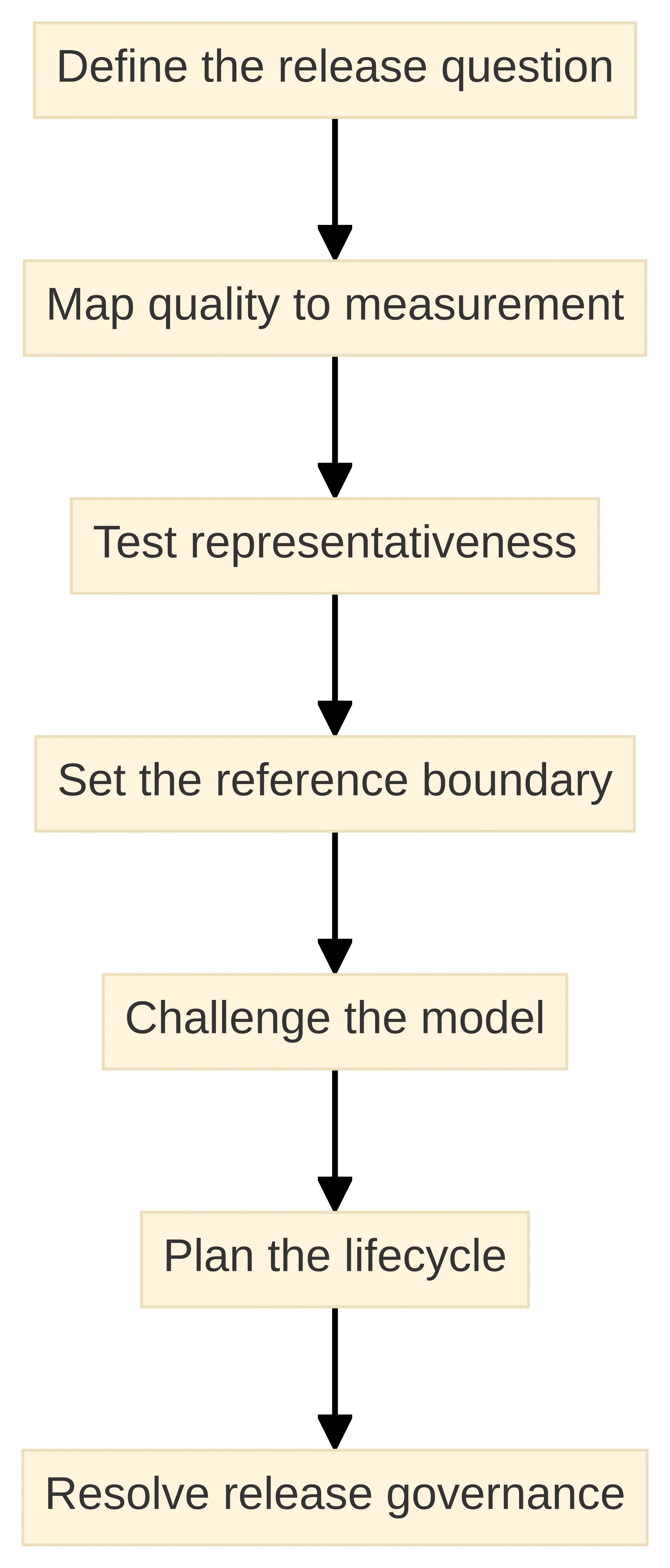
Your assessment can follow a practical sequence from quality intent to release governance:
- Define the release question. State which quality attributes, process stages, and decisions the control strategy must address.
- Map quality to measurement. Identify the critical quality attributes, relevant material attributes, critical process parameters, measured attributes, and control points.
- Test representativeness. Establish whether the in-line or online measurement sees the relevant liquid-phase material under the intended process conditions.
- Set the reference boundary. Define the reference method, its reproducibility, its operating range, and how paired data will be used.
- Challenge the model. Test calibration coverage, model performance on unseen batches, data quality, and behavior across the process domain.
- Plan the lifecycle. Assign responsibilities for instrument performance, model monitoring, change management, investigations, and review.
- Resolve release governance. Determine how the data fit the quality system, documentation, marketing authorization, GMP requirements, and any contingency plan.
The middle of this sequence is analytical, but the decision is wider than analytics. A technically promising spectrum can fail to support release if the sample path is not representative, the reference method is not reproducible, the model does not cover the process, or the quality system has no approved way to act on the result. Conversely, a clear readiness gap does not mean the process is unsuitable; it tells you which evidence a feasibility evaluation must produce before a release discussion can advance.
Use the sequence as a decision record rather than as a procurement checklist. For each stage, record the question, the evidence needed, the responsible function, and the consequence of an unresolved answer. That format lets process development, analytical science, production, quality, and regulatory teams distinguish a missing measurement from a missing decision rule.
Use the control strategy to connect quality to measurement
A control strategy gives the measurement a defined job. Begin with the quality target product profile and the critical quality attributes that determine whether the material meets its intended requirements. Then identify the material attributes and critical process parameters that influence those qualities. The measured variable may be the quality attribute itself or a surrogate, but its relationship to the quality target must be explained at the relevant point of control.
ICH Q8 states that controls should be based on product, formulation, and process understanding and should include appropriate control of critical process parameters and material attributes. The same guidance describes how understanding variability can support upstream control and reduce reliance on end-product testing. That does not make every upstream signal a release measure. It gives you the structure for deciding which signal belongs in the control strategy and why.
Build the link in a form that another function can review:
- Quality requirement: What attribute or product requirement matters?
- Process relationship: Which material or process variables affect it?
- Measured attribute: What does the in-line or online method actually observe?
- Reference relationship: How is the measured attribute related to the reference result?
- Control point: Where and when is the measurement taken?
- Acceptance criterion: What boundary applies at that point, and how was it established?
- Decision use: Is the result for monitoring, process control, investigation, or release?
This map prevents a common category error: treating a measurement rate as evidence of quality relevance. One spectrum per second, a stable signal, or a convenient installation may improve information timing, but none of those facts alone establishes that the data represent a critical quality attribute or can support a batch-release decision. The control strategy has to carry that connection.
Keep the measured attribute and the quality attribute in separate fields in the assessment record. If the method measures a surrogate, state the scientific relationship and the conditions under which that relationship applies. If the measurement is intended only for process monitoring, do not let its output acquire a release role through informal practice.
Choose measurements that represent the liquid-phase process
A useful in-line measurement must represent the liquid-phase material relevant to your decision, not merely material that is easy to expose to a sensor. Define the process location, flow path, timing, and material state before comparing instruments. The control point should have a defensible relationship to the attribute you intend to monitor or control.
Your measurement brief should describe:
- The process stage and the decision that depends on the result.
- The liquid-phase chemistry and the attributes that must be distinguished.
- The expected concentration or composition range for the intended process domain.
- The location, flow behavior, and timing of the measurement relative to mixing, reaction, separation, hold-up, or transfer.
- Conditions that may change the material presented to the measurement path, including the aqueous, strongly absorbing, or low-concentration character of the stream where those conditions apply.
- The sampling or flow-cell arrangement and how it will be cleaned, maintained, and related to the process material.
- The data handling path from measurement to model output, review, investigation, or control action.
The sampling approach still needs scientific development and justification even when the measurement is continuous. More observations do not automatically solve a nonrepresentative location or a poorly defined control point. You need to show why the measured material corresponds to the material covered by the quality decision and how the measurement behaves when the process changes within its intended operating domain.
For pharmaceutical, specialty-chemical, petrochemical, food, or cosmetics processes, the physical setting can change the feasibility question. Ask whether a laboratory evaluation reproduces the process interface and whether the proposed installation fits pressure, cleaning, classified-area, and site-procedure requirements. Record those requirements as part of the measurement brief instead of assuming that a general instrument configuration answers them.
Timing also needs a process interpretation. A measurement taken upstream of a mixing or residence-time step may describe a different material state from a result taken at the intended decision point. Map the delay between the measurement and the quality decision, and state how that delay affects investigation, intervention, or release review.
Make the interface decision in two stages. First ask whether the sample path gives the measurement access to material that is relevant to the intended control point without changing the state that matters to the decision. Second ask whether the path can be operated, cleaned, inspected, and documented under the site’s conditions. A technically suitable spectrum is not enough if the connection creates an unexamined delay, loses representative material, or cannot be maintained consistently.
For an early evaluation, record the physical setting rather than abstracting it away. Those are possible evaluation contexts, not evidence that a model will transfer to every installation. The process team should still check that the pressure, sample interface, chemistry, and operating domain represented in evaluation match the intended use before treating that transfer as relevant evidence.
Make the reference method the analytical boundary
The reference method defines what the chemometric model is being asked to predict. Before collecting calibration data, document the method, its sample preparation, its reportable result, its operating range, and its reproducibility under the conditions that matter to the process. If the reference result is inconsistent, the model inherits that uncertainty rather than correcting it.
Our model predictions cannot be more accurate than the reference method used for training; the reference method’s reproducibility sets the model’s accuracy floor. We develop models by calibrating against your chemistry and reference method, then validating them on unseen batches. Those are specific parts of our stated model-development approach, not a general conclusion that every process will produce a suitable model.
Use the reference boundary to structure the evaluation:
- Confirm that the reference result measures the same attribute, or a justified related attribute, used in the control strategy.
- Establish how samples are taken, preserved, identified, and paired with the in-line or online observation.
- Check that the reference method covers the concentrations and material states expected in the intended process domain.
- Examine reproducibility separately from the model’s prediction error.
- Reserve independent material, including unseen batches where available, for evaluation rather than using every observation in calibration.
- Define how discrepant paired results will be investigated.
A model can fit a training set and still be unsuitable for the process decision if the pairing is weak, the reference method varies, or the evaluation material does not represent the conditions in use. Treating the reference method as an analytical boundary keeps the feasibility question precise: can the measurement reproduce a defined, reproducible reference result for the chemistry and process conditions that the control strategy covers?
Do not hide reference-method limitations inside a single model-performance figure. Separate method reproducibility, sample-pairing variation, instrument variation, and model prediction error in the review record. That separation tells you whether a weak result calls for better sampling, a better reference procedure, broader calibration material, or a different measurement approach.
Challenge the chemometric model across the process domain
A chemometric model is a process-specific analytical relationship, not a permanent translation layer that can be assumed to work whenever the same instrument is installed. Its evaluation should cover the material and operating conditions for which you intend to use the result. Calibration coverage, reference-method reproducibility, paired-data quality, and independent validation all affect whether the model answers the intended question.
Challenge the model in four directions:
- Composition domain: Include the relevant range of concentrations and composition combinations rather than relying on a narrow cluster of convenient samples.
- Process domain: Include the material states and operating conditions that the control strategy covers, with a clear reason for each condition represented.
- Batch independence: Test on unseen batches or other independent material so that evaluation measures transfer beyond the calibration set.
- Decision relevance: Compare model outputs with the acceptance criteria and intended use, not only with a statistical fit from the development data.
Data quality deserves its own review. A timestamp mismatch, poorly documented sample, changed sample state, or unexamined outlier can weaken the relationship between the spectrum and the reference result. Record the chain from process event to sample to reference result to model input so that an unexpected prediction can be investigated rather than treated as an unexplained number.
The model-maintenance literature identifies changing sample matrices, instruments, and responses as reasons that multivariate models may need ongoing maintenance. That makes domain challenge a lifecycle question as well as a development task. Your evaluation should state what variation is covered, what variation is outside the intended use, and what event would trigger reassessment. If those boundaries cannot be stated, the model has not yet earned a defined role in the control strategy.
A useful challenge plan also defines how you will handle material near an acceptance boundary. Review those observations separately from comfortably passing material, because the decision consequence may differ even when the overall model fit appears acceptable. Document the treatment of missing, interrupted, or questionable spectra before the evaluation begins rather than deciding their status after seeing the result.
Plan for model and measurement lifecycle support
A release-oriented measurement system needs support after the first successful evaluation. Sample matrices can change, instruments can change, and the response used by a multivariate model can change. The purpose of model maintenance is to preserve or improve predictive ability as conditions change, so your plan should describe how those changes will be detected and managed.
Assign lifecycle responsibilities before implementation is proposed. At minimum, identify who will own:
- Routine review of instrument and model data.
- Reference-method comparison and periodic assessment of reproducibility.
- Investigation of failed results, unexpected trends, and measurement interruptions.
- Change assessment for the instrument, flow-cell or sample interface, software, model, process, raw material, and operating range.
- Decisions about recalibration, model revision, or withdrawal from a particular use.
- Documentation, training, approval, and communication across process development, production, quality, and regulatory functions.
The quality system must connect these activities. ICH Q10 identifies process performance and product quality monitoring, corrective and preventive action, change management, and management review as elements of a pharmaceutical quality system. Those elements give your organization a structure for governing the measurement and model after feasibility work ends.
Do not define support only as instrument service. A functioning lifecycle also needs a way to recognize when the model no longer describes the process, when the reference method has changed, or when a process change moves material outside the established domain. A model that performs well at installation can require new evidence after a chemistry, equipment, material, or method change. The lifecycle plan should state the decision path for each case and the boundary between continued monitoring, investigation, model maintenance, and revalidation.
Write the lifecycle plan so that an operator can act on it. Define the signal or event that starts a review, the records that must be gathered, the function that approves the disposition, and the conditions under which the measurement is temporarily removed from a defined use. This turns maintenance from an informal technical activity into a controlled part of the measurement strategy.
Separate the triggers that may require review rather than placing every issue under a single maintenance label. An instrument or sample-interface change may require evidence that the response remains comparable. A change in matrix, chemistry, or process conditions may require a new domain challenge. A change to the reference method may require reassessment of the paired-data relationship and its reproducibility. A model or software change may require documented review of the output and its intended use. Making these distinctions explicit helps the team select the relevant evidence instead of assuming that one performance check resolves every type of change.
Include operator readiness in the lifecycle record. The people responsible for the measurement need defined training, operating responsibilities, records, and escalation routes, because effective on-site use depends on more than instrument availability. For a regulated pharmaceutical site, the implementation discussion should also identify whether Installation Qualification (IQ), Operational Qualification (OQ), and Performance Qualification (PQ) services are relevant to the site’s validation plan. Those qualification activities support the controlled installation and operation of the system; they do not, by themselves, establish that a chemometric model is suitable for the intended quality or release decision.
Separate feasibility evidence from release authorization
A feasibility result answers an analytical and process question; it does not grant release authorization. Your organization must still decide how the proposed control strategy fits the quality system, approved process, documentation, marketing authorization, and GMP requirements. The distinction matters whether the site is in Singapore, North America, South America, Europe, or Asia, because the applicable site and jurisdictional requirements must be resolved for the intended use.
The evidence package for a release discussion should make the following points visible:
- Which quality attributes and product requirements the approach addresses.
- Which measured attributes or surrogates are used and why they represent the relevant quality attributes.
- How the reference method, sampling approach, control method, acceptance criteria, and model were established.
- What validation evidence supports the intended use and what conditions remain outside it.
- How failures, trends, interruptions, changes, and investigations are handled.
- How data are reviewed, approved, retained, and connected to the batch record or other controlled documentation.
- What contingency plan applies if the in-line or online result is unavailable or fails an established criterion.
The ICH Q8/Q9/Q10 Q&As state that RTRT results should routinely be used for batch-release decisions rather than being substituted by end-product testing, and that a failure must be investigated with trends followed up appropriately. They also state that any batch-release decision must comply with the applicable marketing authorization and GMP requirements. The EMA guideline states that an RTRT approach should be equivalent to or better than the end-product test and should have a contingency plan. That statement belongs to the cited European guidance; it should not be converted into a universal approval rule for every site.
Keep the handoff explicit. A successful sample or model demonstration can support the next technical review, but the responsible quality and regulatory functions determine whether the proposed use is acceptable for the process and jurisdiction.
For a multinational organization, keep the core technical evidence separate from the site-specific authorization record. The same process measurement may be assessed across locations, but the release procedure, documentation, and regulatory commitments still need to be resolved for each intended use.
Key Highlights
Use these points as a short review checklist before treating an analyzer evaluation as a release project:
- Start with the quality decision and control strategy, not the instrument specification.
- Connect each measured attribute to the relevant quality attribute or justified surrogate.
- Define why the liquid-phase measurement point and sample path represent the material used for the decision.
- Treat the reference method’s reproducibility as a boundary on model performance.
- Separate calibration data from independent evaluation data, including unseen batches where appropriate.
- State the process, composition, and material domain the model covers.
- Plan for changes to the matrix, instrument, response, reference method, process, and model.
- Define how results, failures, trends, investigations, and contingencies enter the quality system.
- Keep technical feasibility evidence separate from the decision to use the approach for release.
If you cannot answer one of these points, record it as a readiness gap. A gap is actionable when it has a defined owner, an evidence requirement, and a decision boundary. That turns a broad request for real-time data into a focused investigation of whether the proposed measurement can support the intended process decision.
A concise readiness record should end with one of three dispositions: proceed to a bounded evaluation, hold while a named gap is closed, or stop because the proposed measurement cannot answer the defined question. The disposition should identify its supporting evidence and the next accountable function.
Apply the readiness gate before selecting a solution
Use a readiness gate to decide whether your process is ready for a serious solution evaluation. The gate does not rank vendors. It tests whether the process question is defined well enough for a technical comparison to produce useful evidence.
Gate 1: Quality connection. You can identify the quality attributes, relevant material attributes, critical process parameters, and product requirements that the proposed control strategy must address. If the quality connection is unclear, hold the investigation at process and product definition.
Gate 2: Measurement representation. You can specify where, when, and how the liquid-phase material will be measured, and why that point represents the material covered by the quality decision. If the interface or control point is uncertain, resolve representativeness before comparing instruments.
Gate 3: Sampling rationale. You have a scientifically developed and justified approach to collecting, pairing, or interpreting observations. If continuous measurement is proposed without a sampling rationale, the gate remains open.
Gate 4: Reference boundary. You have a defined reference method with known reproducibility and a plan for paired data. If reference results cannot be interpreted consistently, improve the analytical basis before judging the model.
Gate 5: Model challenge. You have identified the intended process domain and can reserve independent material for evaluation. If the model will be judged only on its calibration data, the gate is not passed.
Gate 6: Lifecycle ownership. You have assigned responsibility for monitoring, change control, investigation, maintenance, and review. If support ends at installation, the proposed release use is incomplete.
Gate 7: Release governance. Your quality and regulatory functions have identified the documentation, authorization, GMP, failure, trend, and contingency questions that require resolution. If the release pathway is undefined, limit the project to feasibility evidence.
A go decision means that a process-specific investigation has a defined question, evidence package, and handoff. A hold decision means that the next action is to close a named readiness gap, not to infer that a faster measurement will solve it.
Use the gate before spending effort on an extensive comparison. It does not replace technical testing; it makes the testing answer a defined question and creates a clear boundary for interpreting the result.
Make each gate auditable by recording its current status, the evidence supporting that status, the accountable function, the next action, and the consequence of leaving the issue unresolved. Distinguish an answer that is ready from an answer that is unknown or not met; an unknown should not be treated as a pass merely because the instrument evaluation has not yet found a problem. This distinction keeps missing evidence visible and prevents an exploratory result from being mistaken for readiness.
Score the gate against the intended use as well as the process. A process may be sufficiently defined for a process-understanding or monitoring study while remaining unready for a release-related application because its acceptance criteria, validation evidence, or governance pathway is incomplete. Record that boundary before testing begins. None of those dispositions is itself release authorization; each simply determines the appropriate next decision.
Use a bounded process evaluation to resolve the unknowns
A bounded process evaluation should answer a defined feasibility question tied to the intended use. Before requesting that evaluation, assemble a concise process brief rather than sending only an instrument category or a target measurement rate.
Include:
- Process identity: Describe the reaction, process stream, stage, batch or continuous setting, and intended decision point.
- Chemistry: List the relevant components, expected concentration or composition ranges, and material characteristics that may affect the measurement.
- Quality question: State the quality attributes, process variables, or release-related decisions the measurement is expected to inform.
- Reference method: Identify the method, result definition, reproducibility information, sample handling, and acceptance criteria used for comparison.
- Sample set: Describe the available process samples, batches, conditions, and any material that represents the intended operating domain.
- Measurement setting: Record flow, pressure, temperature, cleaning, access, classified-area requirements, and other site conditions that determine the practical interface.
- Data and model plan: State whether the objective is monitoring, process understanding, model development, independent validation, or a release-related feasibility question.
- Governance: Identify the functions that will review the result and the decision that follows a pass, a failure, or an unresolved result.
We also offer to test OrionIR® on customer process samples when appropriate. Those activities can make a discussion more concrete, but the evaluation still needs a defined reference boundary, representative samples, and a stated decision use.
A useful evaluation can produce a no-go result for the proposed measurement, model, or process condition. That is a valid outcome when it identifies a mismatch before a larger implementation effort. Define the no-go criteria in advance, including what would require a different sample interface, a revised reference method, additional process coverage, or a decision to stop the investigation.
Keep the evaluation question narrow enough to interpret. A result that establishes measurement compatibility is not automatically a result that validates a release model. State which unknown each test addresses and which questions remain outside its scope.
Position OrionIR as a conditional measurement option
We offer OrionIR® as a mid-IR spectrometer that provides one spectrum per second across 900–3500 cm⁻¹ through aqueous, strongly absorbing, and low-concentration streams. That is a stated measurement specification for OrionIR®, not evidence that the instrument alone establishes release suitability for your process.
For a liquid-phase RTRT investigation, assess whether the stated measurement specification addresses the defined process point, reference method, and decision use.
Our model-development approach calibrates against your chemistry and reference method, then validates the model on unseen batches. For an OrionIR® evaluation, examine reference-method reproducibility before interpreting model predictions. Those conditions should remain visible in any OrionIR® feasibility discussion.
Use the product information to frame questions, not to skip the readiness gate:
- Can the proposed measurement path observe the relevant liquid-phase material at the intended control point?
- Can the process samples represent the composition and operating domain covered by the proposed use?
- Is the reference method reproducible enough to establish a meaningful model boundary?
- Can independent batches or other independent material be reserved for validation?
- What data, model, maintenance, and quality-system records will the site require?
- What remains a feasibility result, and what would require separate quality or regulatory approval?
This conditional position keeps the instrument in its proper role: a possible measurement component within a control strategy whose suitability depends on the process, method, model, lifecycle, and governance evidence.
Move from readiness questions to a process-specific review
Your next decision is whether the process has a defined enough quality, measurement, reference-method, model, lifecycle, and release-governance question to justify a bounded evaluation. If it does, prepare the process brief with the stream chemistry, intended control point, reference method, representative samples, operating setting, and decision use. If it does not, use the readiness gaps to determine what must be characterized before technical selection.
We can address the measurement and process-specific questions within the information supplied for review; the resulting discussion remains a feasibility step rather than a booked demonstration or a release approval.
What should a team confirm before requesting an RTRT feasibility assessment?
What is real-time release testing (RTRT)?
Real-time release testing (RTRT) uses process data to evaluate in-process and final-product quality within an established control strategy, distinguishing it from traditional offline testing that relies on discrete samples tested after collection.
What are the key considerations for implementing RTRT in a liquid-phase process?
Key considerations include defining quality attributes, ensuring representative measurements, establishing a reliable reference method, validating chemometric models, and planning for ongoing lifecycle support.
What role does the reference method play in RTRT?
The reference method defines the analytical boundary for the chemometric model, ensuring that predictions are based on reproducible and relevant results.
What should be included in a bounded process evaluation for RTRT?
A bounded process evaluation should include a description of the process, relevant chemistry, quality questions, reference methods, sample sets, measurement settings, and governance for reviewing results.
What is the importance of model maintenance in RTRT?
Model maintenance is crucial to preserve or improve predictive ability as conditions change, ensuring that the model remains valid for the intended process use.
How does the readiness gate help in evaluating RTRT solutions?
The readiness gate helps determine if the process is defined well enough for a technical comparison, assessing quality connections, measurement representation, sampling rationale, reference boundaries, model challenges, lifecycle ownership, and release governance.