
How much does trace gas detection cost in Singapore?
How much does trace gas detection cost in Singapore?
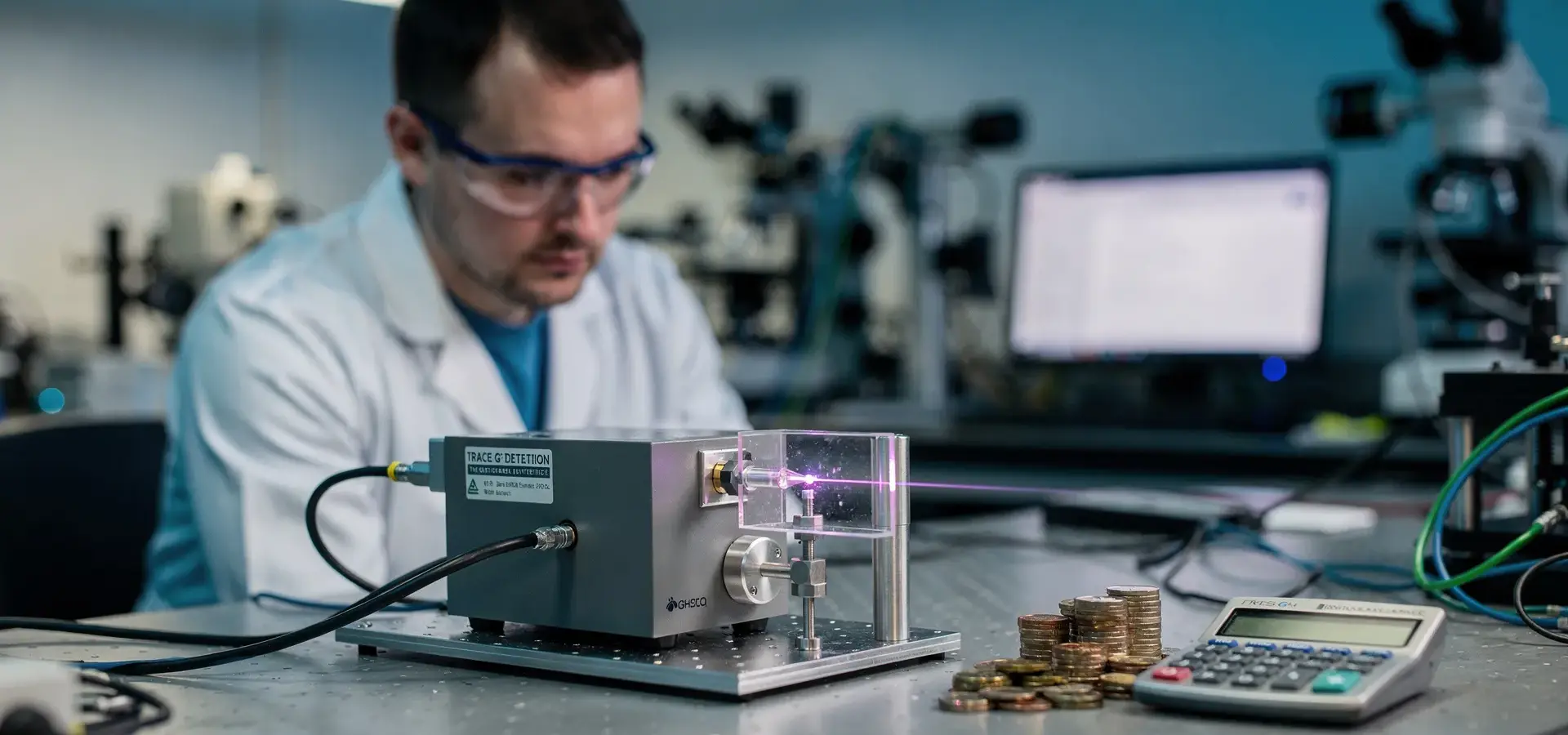
Turn the cost question into a measurement decision
A defensible Singapore budget starts with the measurement result you need, not with a headline instrument price. Many gases are colorless and odorless, so leakage can readily go undiscovered; detectors can calculate the concentrations of gaseous species in a target atmosphere. That makes the target gas, concentration range, detection limit, response time, sampling location, and operating environment the first cost questions to resolve.
No single equipment figure can represent every trace-gas project. A laboratory experiment, a pilot side stream, a continuous process measurement, and an exposure-monitoring programme can require different sensing performance, sample handling, documentation, and site work. Treat the budget as a set of scopes that you can compare separately: the measurement instrument, the sample path, integration, implementation, quality requirements, and ongoing support.
Use this sequence before requesting prices:
- Define the decision the measurement must support.
- Record the gas or gases, expected concentration range, required detection limit, and response time.
- Describe where the sample will come from and what the site can expose the system to.
- Separate equipment from installation, commissioning, qualification, calibration, and service.
- Ask each supplier to price the same scope and provide the same performance evidence.
This method gives you a Singapore-relevant budget without inventing an average market price or treating one configuration as suitable for every application.
Classify the Singapore use before specifying equipment
The Singapore use case determines what the measurement must demonstrate. Research and process-development work may focus on concentration trends, reaction behaviour, or product development. Workplace exposure monitoring has a different purpose: in Singapore, workplaces that use or generate toxic substances and expose employees to them need monitoring to determine the contaminant level in the air. The monitoring frequency depends on the contaminant level compared with the Permissible Exposure Limit (PEL).
Singapore sampling guidance changes the scope when you are assessing personal exposure rather than a process stream.
Grab samples should not be used to determine 8-hour exposures; long-term integrating samples should be used for full-shift exposure assessment.
Before you ask for a quote, write down:
- Whether the result is for research, process control, gas-quality verification, or workplace exposure assessment.
- The contaminant and the concentration range you expect.
- Whether the result must represent a person, an area, a process line, a vessel, or a gas distribution system.
- The exposure pattern, including short events, steady conditions, shift duration, and concentration variation.
- The worker groups or process locations covered by the assessment.
If your project is occupational monitoring, include these conditions in the commercial scope rather than treating them as an optional field service.
Set performance targets before comparing laser architectures
Sensitivity requirements can move the project into a different instrument class. Low-cost chemiresistive methane sensors perform as expected at concentrations greater than approximately 100 ppm, but they do not meet the ppm or sub-ppm sensitivity required for environmental monitoring. Larger, more costly devices are required for precision methane measurements at the ppm level. Some gas analyzers provide online, real-time measurements at and below ppbv, so you should state the required measurement range rather than assume that the word “trace” identifies a single performance tier.
Laser architecture is part of that performance decision. TDLAS has been popular for more than 20 years in academic and research circles; commercial applications began to appear more than 10 years ago and have reached the mainstream in many markets. Near-infrared TDLAS systems have achieved parts-per-million detection limits over short pathlengths of approximately 1-10 m and have relatively low costs.
Room-temperature interband cascade lasers operating in the 3-6 µm region allow access to more fundamental bands. Quantum cascade lasers typically operate at 5-12 µm and may see wider industrial application limited by the price associated with power, packaging, and stability requirements. These technology and cost relationships do not establish that a near-infrared, interband-cascade, or quantum-cascade configuration fits your gas or concentration range.
Put the following targets in the same line of your quote brief:
- Target gas or gases, including possible interferents.
- Minimum and maximum concentration to be measured.
- Detection limit and the conditions under which it must be achieved.
- Response time, update interval, and whether the result is continuous, online, or periodic.
- Required path length and sample volume.
- Required wavelength range and whether the range must be fixed or tunable.
- Whether the measurement is for a controlled laboratory sample, a process stream, or an outdoor or workplace atmosphere.
A lower headline price is not a useful comparison if it meets a different detection limit, response time, or gas-coverage requirement.
Choose the sample path from site conditions
The sample path can change both the quoted configuration and the work required at the site. Pumped sampling is favored when the sampling point is too hot or cold, difficult to access, contains heavy vapor that does not diffuse well by natural forces, can support conversion from an explosion-proof rating to a general-purpose rating through pumped operation, or involves a confined space. An application can be converted from an explosion-proof rating to a general-purpose rating through pumped operation, although flashback arrestors may be necessary between the sample port and the sensor.
Aspirated sampling uses suction to draw a sample from a remote location into or through the sensor; compared with pumped sampling, it has lower cost and reduced maintenance because it has no moving parts. Treat that comparison as a characteristic of these sampling arrangements, not as a promise that aspiration will suit your site.
Describe the sample point precisely. Include temperature, pressure, access, expected vapour behaviour, possible condensation or particulates, hazardous-area requirements, confined-space conditions, line length, and whether the sample must travel from a remote location. Keep sampling lines as short as possible when using an aspirated or pumped sampling system.
For refrigerant work, most refrigerant gases are heavier than air, so monitor them close to the floor; pits, stairwells, and trenches may fill with refrigerant gas before the main area. The right position still depends on whether your measurement is an area assessment, a personal exposure assessment, or a process sample.
Path length and sampling volume should appear as explicit quote fields. One compact multispecies sensor used an 8.8 cm-long multipass gas cell with a 3.0 m effective optical path length and a 75 mL sampling volume. Those dimensions describe that sensor configuration; they are not default requirements for your project.
If you are assessing a full shift, the sampling schedule also belongs in the path specification. Ask suppliers to identify whether their proposed sample path can support the required duration and whether the quoted result is a grab, integrated, or continuously updated measurement.

Convert requirements into a configuration brief
A configuration brief should connect the application to a defined instrument version rather than list a product name alone. Record the operating pressure, sample location, temperature range, hazardous-area classification, required wavelength range, power available at the installation, communication interfaces, model or calibration expectations, and whether the system will remain in a laboratory or move into a plant environment.
The brief should also state what happens after evaluation. Identify whether a laboratory result must transfer to a pressurized installation, whether the system will connect to process-control or data systems, and whether the site requires documentation or qualification before use. These details allow a supplier to separate a base instrument from application-specific work.
Our documented OrionIR® options illustrate why the configuration must follow the application. We have field-tested the OrionIR® under industrial conditions in North America, South America, Europe, and Asia. The measurement principle of our OrionIR® High-Pressure Version is unchanged from the Lab version.
Our OrionIR® Plant version is intrinsically safe at 0.6 W; we offer a separate ATEX-certified series where a certificate is required. These are documented product facts, not a conclusion that a plant, laboratory, or hazardous-area version is suitable without an application assessment.
Power and wavelength choices also belong in the commercial comparison. Our OrionIR® High-Pressure Version requires 600 mW at 5 V via one USB-C cable. Our OrionIR® TEC version operates under 9 W with a DC 9 V supply. We offer the K2-OPO with a fixed or tunable wavelength range chosen at the time of order.
Ask each supplier to state the power supply, wavelength selection, environmental limits, and included accessories in the same format. A configuration that meets the optical requirement but needs unpriced electrical, sample-handling, or site modifications is not comparable with a fully scoped alternative.
Separate the instrument from the full commercial scope
Build the budget as a ledger with separate lines for:
- Base instrument and detector configuration.
- Laser source, wavelength selection, optical path, and software.
- Sample probe, cell, lines, filters, valves, pumps, conditioning, and hazardous-area hardware.
- Calibration materials, reference methods, model development, and laboratory analysis.
- Factory acceptance testing, delivery, installation, commissioning, and site acceptance.
- Validation, qualification, documentation, training, warranty, maintenance, and support.
- Integration with data, control, security, or process systems.
- Import, freight, insurance, duties, taxes, and other commercial inputs that the supplier has explicitly identified.
Do not collapse these lines into an “all-in” number until you know what each line includes and which party is responsible for it.
The service scope can be substantial. Gas analysis services can include complex composition analysis, ultra-high-purity analysis down to ppt level impurities, calibration and maintenance, system design and validation, factory acceptance testing, installation, and commissioning. Process gas testing services can include pharmaceutical gas testing, commissioning qualification and validation of pharmaceutical plants, routine monitoring of gas installations, qualification of gas storage, purification and distribution systems, and laboratory analysis of industrial, medical, and high-purity gases.
Singapore trace-gas analysis services may measure moisture and oxygen in gas systems down to low PPB levels and may provide 24/7 emergency response across Singapore. Industrial gas suppliers and distribution networks must verify delivery gas purity to meet customer specifications and quality standards. After gas-system installation or modifications, testing can confirm removal of oxygen and moisture contaminants and verify that gas distribution systems meet purity specifications. Treat these as possible scope items to identify, not as amounts to insert into your budget without a defined requirement.
Singapore import costs need a documented commercial basis. An IRAS example calculates GST payable on imported goods as ($450 + $50 + $50) × 9% = $49.50, using $450 for the goods, $50 for insurance and freight, and $50 for customs duty. That example measures GST in a particular imported-goods scenario; it is not a trace-gas instrument price, a universal project total, or a substitute for the transaction details applicable to your shipment.
Ask for the assumed customs value, freight, insurance, duty treatment, tax treatment, delivery point, and responsibility for clearance. Keep those assumptions beside the equipment and implementation lines so you can revise them without changing the technical comparison.
Prepare a quote brief suppliers can answer consistently
Give every supplier the same technical brief. Include:
- Target gas or gases, expected interferents, and concentration range.
- Required detection limit, accuracy or precision objective, response time, and update interval.
- Sample source, pressure, temperature, moisture, particulates, line length, and access conditions.
- Required measurement mode: laboratory, side stream, online, in-line, area, or personal exposure.
- Required wavelength range, path length, sample volume, hazardous-area classification, and power supply.
- Calibration or reference method, data output, communication interface, and software requirements.
- Expected operating schedule and whether the result must support a full-shift assessment.
Add the project information that can change implementation scope: installation location, site access, classified-area requirements, integration interfaces, cybersecurity or security standards, factory acceptance testing, commissioning, qualification, validation, training, warranty, preventive maintenance, calibration, spare parts, and response arrangements. We encourage early discussion about integration requirements to expedite agreement on security standards.
If your work involves pharmaceutical gases, distinguish the instrument qualification from separate gas testing or plant qualification. SGS provides onsite pharmaceutical gas testing for nitrogen, oxygen, and carbon dioxide, including testing for compliance with international pharmacopeia monographs. SGS also offers commissioning qualification and validation activities for pharmaceutical plants, routine monitoring of gas installations, and qualification of new gas storage, purification, and distribution systems.
Ask suppliers to mark each deliverable as included, optional, or excluded. The response should identify who supplies calibration standards, who performs site acceptance, what reports are delivered, how training is handled, and what maintenance or calibration interval is assumed. SGS provides onsite preventive and corrective maintenance, onsite calibration of gas detectors and gas analyzers, design and validation of complex gas analysis systems, factory acceptance testing, installation, and commissioning; use that service scope as a prompt for comparison, not as a claim about every supplier’s proposal.
If your project is still exploratory, say so. A supplier can then distinguish a feasibility evaluation, a laboratory setup, and a production-ready installation instead of pricing them as though they were the same purchase.

Normalize quotes by performance evidence and included work
Normalize each response against the same performance evidence. Compare the stated detection limit at the same gas concentration, pressure, temperature, path length, response time, and interferent conditions. Keep reported performance figures attached to their stated configuration rather than treating them as general specifications for all laser sensors.
The quote should also identify the measurement method. Direct absorption spectroscopy quantifies gas concentration by baseline fitting, but laser-power fluctuations and particle scattering or absorption can introduce interference and extra uncertainty. WMS shifts detection to higher frequencies and improves detectivity; WMS-2f/1f normalizes the second-harmonic signal by the simultaneously recorded first-harmonic signal to reduce optical-power-fluctuation effects.
Compare the commercial scope as carefully as the optical result. For every quote, mark whether the price includes sample handling, calibration, data processing, software, installation, commissioning, qualification, validation, training, warranty, maintenance, spare parts, and integration. A lower figure may represent a narrower scope rather than a lower cost for the same system.
Regulatory compliance frameworks may impose QA requirements regardless of an analyzer’s inherent stability; a CEMS measurement subject to EN 14181 must pass QAL2 and AST procedures even if analytical recalibration is not required. When you compare field evidence, ask whether the stated conditions, gas matrix, installation, and acceptance criteria resemble your project.
Calibration and acceptance evidence should be specific enough to reproduce the comparison. Ask how the supplier establishes the response, checks drift, handles overrange events, and records the result. In one reported experience, testing carbon monoxide detectors with vehicle exhaust caused overrange and drift; education and field calibration equipment solved the issue. That experience does not predict your instrument’s behaviour, but it shows why the quote should state the calibration material, method, training, and field equipment rather than simply promise periodic calibration.
Seek qualified evaluation when exposure or compliance is consequential
Singapore’s stated monitoring schedule depends on contaminant concentration compared with the PEL: once every 3 years at less than 10% of PEL, at least once a year at 10% to 50% of PEL, at least once every 6 months at greater than 50% to 100% of PEL, and at least once every 3 months at greater than 100% of PEL until exposure is reduced below the PEL. Singapore hygiene monitoring includes toxic-substance and noise monitoring, and must be carried out by a competent person.
These intervals affect the monitoring plan and therefore the ownership scope. They should not be converted into a generic service frequency for every trace-gas instrument.
For an exposure-related project, include the following controls in the evaluation brief:
- If exposure lasts less than 6 hours, partial-period sampling covering the exposure period could be conducted under the Singapore guidelines.
- Grab samples are usually used for short-term exposure levels and should not be used under the Singapore guidelines to determine 8-hour exposures.
- Sampling pumps should be calibrated before and after sampling to set and verify flow rate, using a primary standard such as a soap bubble meter or electronic film flow meter.
- Use a soap bubble meter or electronic film flow meter as a primary calibration standard; calibrate a rotameter to a primary standard at regular intervals if it is used as a secondary standard.
Each item affects what the system must measure, how it must be operated, or what evidence the resulting report must contain.
Escalate the evaluation when the result could affect worker protection, regulatory reporting, plant acceptance, or a decision to reduce controls. Ask the competent person responsible for the monitoring plan to define the representative location, sampling duration, sample count, calibration method, and acceptance criteria before you compare equipment. Price comparison becomes meaningful only after those conditions are fixed.
Move from a generic price question to a scoped quote discussion
A useful Singapore budget is a normalized scope, not a universal price. Start with the result you need, then connect the target gas and performance requirement to the sample path, site conditions, instrument configuration, implementation work, compliance deliverables, and ongoing support. Keep import assumptions and optional services visible instead of hiding them inside an all-in figure.
Prepare one concise project brief containing:
- Target gases, concentration range, detection limit, and response time.
- Sample location, pressure, temperature, line length, hazards, and monitoring pattern.
- Required wavelength range, gas coverage, data interface, and power conditions.
- Installation, commissioning, qualification, validation, calibration, training, and maintenance scope.
- Singapore delivery assumptions and the performance evidence you expect in the response.
For exposure or compliance decisions, have a competent person determine whether the proposed monitoring plan is suitable for the intended result. Then use the completed brief to request a like-for-like scope discussion.
What should a Singapore trace-gas detection quote request include?
How much does trace gas detection cost in Singapore?
There is no defensible universal price. The budget depends on the target gas, concentration range, detection limit, response time, laser architecture, sampling path, hazardous-area requirements, integration, commissioning, qualification, and support. Request a configuration-specific quote rather than relying on an average or headline figure.
What should a Singapore trace-gas detection quote include?
Ask suppliers to separate the instrument, laser and optical configuration, sample cell and lines, pumps or conditioning, calibration materials, software, installation, commissioning, training, warranty, maintenance, validation, integration, and delivery assumptions. Each item should be marked included, optional, or excluded so different proposals represent the same scope.
Which details should I provide before requesting a quote?
State the target gas or gases, expected concentration range, required detection limit, response time, sample source, pressure, temperature, moisture, particulates, line length, access conditions, hazardous-area classification, wavelength range, power supply, data interface, calibration method, and operating schedule. Also identify whether the result is for research, process control, gas-quality verification, area monitoring, or personal exposure assessment.
Does occupational monitoring require a different budget from process or research measurement?
Usually, yes. A research or process system may instead prioritize continuous trends, reaction behaviour, or process-stream data, so those requirements should not be priced as interchangeable scopes.
How should I account for Singapore import charges in the estimate?
Keep freight, insurance, customs value, duty treatment, taxes, delivery, and clearance responsibilities as separate commercial assumptions. An IRAS example calculates GST on imported goods as ($450 + $50 + $50) × 9% = $49.50, using $450 for goods, $50 for insurance and freight, and $50 for customs duty; that example is not a trace-gas instrument price or a universal project total.