
paeonia
What Does “Paeonia” Refer To? How to Assess Paeonia Innovations for Trace-Gas Detection
Resolve what “paeonia” identifies before assessing relevance
The term “paeonia” does not identify Paeonia Innovations by itself. Treat it as a company match only when your search concerns trace-gas detection, laser spectroscopy, chemical-analysis instruments, or related photonics work and the result leads to our own website. A short, lowercase search term can point to more than one subject outside this technical context.
We are Paeonia Innovations, the Singapore-based organization associated in this context with OrionIR® mid-infrared spectroscopy and K2 Photonics dual-comb lasers. Our portfolio connects those technologies with chemical analysis, trace-gas detection, and photonics research. The identification basis is therefore the combination of the organization name, its technical subject matter, and our domain—not the word “paeonia” in isolation.
The identity check should precede the technical assessment:
- Match the organization. Establish that the result concerns Paeonia Innovations rather than an unrelated use of the term.
- Match the application. Decide whether your question concerns trace gases, absorption spectroscopy, continuous chemical measurement, ultrafast spectroscopy, or another listed use.
- Match the decision. Separate a request for technical information from a request for sample testing, integration planning, or an instrument evaluation.
If your search intent stops at the name, you have not yet established a measurement fit. If your work involves a defined gas, optical measurement, and application context, you can move from identity to requirements. The phrase used in the title is a search-context label; it is not evidence that any particular instrument will meet your conditions.
Place Paeonia Innovations in its supplied company context
Paeonia Innovations is the Singapore-based organization identified in this context. We were founded in April 2023 as a spin-off from ASTAR, and our technology is licensed from ASTAR. Those facts describe our origin and technology relationship; they do not, by themselves, establish that a particular measurement arrangement is suitable for your project.
Paeonia Innovations’ portfolio includes compact chemical-analysis instruments and photonics technologies. K2 Photonics dual-comb lasers are associated with trace-gas detection, high-resolution absorption spectroscopy, and other photonics applications. These are different technical routes and should not be treated as interchangeable product descriptions.
The portfolio distinction determines which question you should bring forward. A gas-sensing researcher may be asking about narrow absorption lines and species identification. A photonics OEM may be assessing a dual-comb source for integration. A process-development team may need continuous observation from a reactor loop or pilot side stream. An academic laboratory may instead be investigating pump–probe, transient absorption, or time-resolved spectroscopy.
The same organization can appear in all four conversations, but the requirements are not the same. State the application first, then identify the optical source, spectrometer, sample arrangement, or integration support that belongs in the discussion. Keep our Singapore base and A*STAR connection as identity context, not as a substitute for technical assessment.
Overview
The relevance map for Paeonia Innovations starts with the measurement problem rather than the organization name:
- Trace-gas detection: Our stated use case is gas-phase absorption measurement in which resolving narrow lines can support species identification. Our materials present comb-based sources as providing resolution and broad coverage in a single acquisition.
- Dual-comb photonics: K2 Photonics dual-comb lasers are listed for high-resolution absorption spectroscopy, trace-gas detection, pump–probe work, time-resolved spectroscopy, terahertz time-domain spectroscopy, and optical frequency metrology.
- Continuous chemical measurement: OrionIR® is described as delivering real-time, continuous measurements and generating one spectrum every second. That description concerns the stated measurement behavior, not a guarantee of detection performance for your gas.
This map answers the first relevance question: your project belongs in the conversation if its measurement problem resembles one of these stated uses. It does not answer whether the gas composition, concentration range, accuracy requirement, temperature, pressure, physical interface, and reference method can be addressed.
The evaluation path has three stages:
- Identity: Establish that Paeonia Innovations is the organization you intended to find.
- Technical route: Determine whether your problem points toward trace-gas absorption, dual-comb spectroscopy, OrionIR® continuous measurement, or a different discussion.
- Project definition: Prepare enough information for a technical conversation to distinguish a general inquiry from a process-specific feasibility question.
The third stage prevents a product name from carrying more meaning than it can support. A product label can orient the conversation; your measurement conditions determine what must be examined next. If the application, target species, and operating setting remain undefined, the appropriate next step is to clarify those points rather than infer a fit.
Start with the measurement question, not the product name
The first technical question is not “Which Paeonia Innovations product should I buy?” It is “What must the measurement distinguish, and under which conditions?” That wording keeps the inquiry tied to the experiment or process rather than forcing an early conclusion about a device.
Define the object of measurement in plain terms. You may need to identify one gas species, several species in the same acquisition, a change over time, a concentration range, or a chemical activity in a process stream. You may also need to distinguish a research instrument from a source intended for integration into an OEM system. Each objective changes the information that matters in the next discussion.
For a trace-gas question, write down the species of interest and the surrounding gas matrix. Add the expected concentration range and the accuracy you need to assess. For a process-monitoring question, describe whether the sample comes from a recirculation loop, a pilot side stream, a bench arrangement, or another location. For an OEM question, describe the space, optical, electronic, and interface constraints that already shape the product design.
The initial measurement brief should answer these questions:
- What species or chemical feature must you measure?
- Is the measurement for a laboratory experiment, a pilot setup, a production-related stream, or integration into a product?
- Do you need a single result, repeated observations, or continuous measurement?
- What concentration range and accuracy requirement should the discussion address?
- What temperature, pressure, stream composition, and solids content will the measurement encounter?
- What reference method do you use now, and how reproducible is it?
- What must connect to the measurement arrangement: a reactor loop, side stream, bench setup, gas cell, or OEM system?
These questions do not select an instrument for you. They create a bounded problem that can be discussed without treating a general application page as a project-specific recommendation. If you cannot answer every question, mark the unknowns and ask for a consultation about the measurement process, chemistry, and partnership or integration context.
The decision boundary is the difference between a defined question and a product-name search. A defined question names what must be measured, where the material comes from, how the result will be used, and which conditions may affect the measurement. A product-name search supplies none of those limits.
Write the minimum requirement before comparing routes. For example, “measure two gas species in a defined matrix at a specified pressure and compare the result with our current method” is a more useful starting point than “find a fast spectrometer.” The first statement gives the technical discussion something to test; the second leaves the central problem open.
Understand why line resolution matters for trace gases
Trace-gas detection depends on what the measurement can resolve, not only on the broad spectral region it covers. Gas-phase absorption lines are narrow and largely unblended at low pressure, which makes them highly specific when the measurement resolves them. That condition is the important boundary: a spectral band alone does not establish that the lines needed for your species can be distinguished.
Our trace-gas material also identifies comb-based sources as providing the resolution and broad coverage needed to identify several species in one acquisition. The phrase “several species” describes the stated application principle; it does not tell you which species, concentration range, pressure, path length, or accuracy your project will support. Those conditions belong in the technical inquiry.
For an academic experiment, ask which spectral features are central to the hypothesis and whether the measurement must separate nearby lines. For a product-development project, ask how the source and detector arrangement will be incorporated and what the operating environment requires. For a process stream, include pressure, temperature, composition, and solids in the brief so the team can address the actual sample setting.
The line-resolution discussion should address four distinct points:
- Feature: Which absorption line or group of lines represents the species or change you need to observe?
- Separation: Could other species in the gas matrix create nearby or overlapping features that the measurement must distinguish?
- Conditions: At what pressure and temperature will the gas be measured, and how will it reach the measurement region?
- Coverage: Do you need one narrow region or broad coverage for several species in one acquisition?
The first two points describe the analytical question. The last two describe the measurement setting. Keep them separate when you contact the team. A source may be relevant because it is listed for high-resolution absorption spectroscopy, while the actual feasibility question still depends on your gas mixture and operating conditions.
Map K2 Photonics to the stated spectroscopy use case
K2 Photonics belongs in your discussion when the requirement involves a dual-comb source, high-resolution absorption spectroscopy, or a related ultrafast and photonics application. We list trace-gas detection and high-resolution absorption spectroscopy among the applications for K2 Photonics dual-comb lasers. The same list includes pump–probe studies, transient absorption, time-resolved spectroscopy, terahertz time-domain spectroscopy, optical frequency metrology, and integration into optical devices or ultrafast systems by OEM developers.
Our dual-comb description provides the operating principle at a high level. Interference between two combs down-converts an optical spectrum into the radio-frequency domain, where a single fast photodetector measures it. This approach also has high resolution and broad bandwidth, with no moving parts and no dispersive spectrometer. These characteristics explain why the source appears in both gas-sensing and broader photonics contexts; they do not remove the need to define the experiment or system interface.
The K2 Photonics route is worth investigating when your project has a clear reason to discuss comb-based spectroscopy. Suitable reasons to open that conversation include:
- resolving gas-phase absorption features;
- seeking broad coverage for several species in one acquisition;
- building a high-resolution absorption experiment;
- integrating a comb source into an optical, ultrafast, or gas-sensing product; or
- examining a pump–probe, time-resolved, terahertz, or frequency-metrology application.
The application list does not establish a conclusion about your project. Describe the source as a candidate technical route, then provide the spectral region, target species, measurement geometry, acquisition objective, and integration constraints. If your question concerns a complete continuous chemical measurement rather than a source for an optical system, explain that distinction so the team can direct the discussion toward the relevant part of the portfolio.
Position OrionIR® as a stated continuous-measurement option
Paeonia Innovations states that OrionIR® delivers real-time, continuous measurements and generates one spectrum every second. We also describe the device as supporting continuous observation of chemical activities and providing real-time data for immediate adjustments and optimization. These statements position OrionIR® as a continuous-measurement option for a defined chemical-analysis problem, rather than as a generic replacement for every spectroscopy arrangement.
The rate of one spectrum every second answers a timing question: how frequently the described system generates a spectrum. It does not establish the response time for a complete process decision, the detection limit for your gas, the accuracy of a concentration result, or the suitability of a particular sample interface. Keep those questions separate. A measurement cadence is one project requirement, not a complete performance conclusion.
That stated arrangement may be relevant when your work involves continuous chemical observation. It does not establish that your connection, materials, pressure, temperature, or stream composition can be accommodated without a project-specific discussion.
Use OrionIR® as the starting point when your central question concerns continuous chemical observation. Describe what must be observed, how often the result must be available, where the sample originates, and what you use as the reference method. If your central question instead concerns optical frequency structure, narrow gas absorption features, or an OEM source, K2 Photonics may be the more direct route for the initial inquiry. The distinction keeps the conversation focused without treating either technology as a universal answer.
Check the physical measurement setting before contacting the team
The physical measurement setting can change the questions attached to an otherwise clear requirement. A gas sampled from a reactor recirculation loop is not described in the same way as a gas presented in a bench setup, and a pilot side stream may introduce conditions that do not appear in a laboratory description. Start by locating the measurement point and tracing what reaches it.
Record the path from the source to the measurement arrangement:
- where the sample is taken;
- whether it comes from a recirculation loop, pilot side stream, or bench setup;
- whether the stream is continuous or intermittent;
- the stream composition and expected concentration range;
- temperature and pressure at the sampling point and measurement point;
- the presence of solids; and
- the method used today to establish or check the result.
The OrionIR® Lab version is designed for the three named laboratory and pilot arrangements, but that description is not a universal approval for every process interface. Your conditions still determine which questions must be answered.
The operating location should be part of the initial discussion. A university laboratory, photonics development lab, pilot plant, and production-related site may have different access, integration, documentation, and operating requirements. Projects across North America, South America, Europe, and Asia may also involve different local site practices and facility constraints, so record the actual location and operating environment rather than assuming that a laboratory arrangement transfers unchanged.
If your work occurs in a classified area, a continuous-manufacturing environment, or a regulated site, identify that constraint as part of the initial discussion. Do not infer a certification, installation pathway, or regulatory acceptance from the existence of a product page. Ask the team to address the specific site and integration question through the appropriate technical process.
The sample interface deserves its own short description. State whether the material reaches the measurement directly, through a side stream, or through a laboratory arrangement, and identify any transition between the process and the measurement point. Note which interface conditions are known and which still need examination.
This distinction helps separate an optical question from a sample-presentation question. A source can be relevant to the spectral task while the physical arrangement remains unresolved. Keep both questions visible instead of allowing a listed application to stand in for an interface assessment.
Prepare the requirements that determine a useful discussion
A useful inquiry gives Paeonia Innovations enough information to understand the measurement problem before discussing a route. For sample testing, we ask for the reference method currently used and its reproducibility. We also require the stream composition, concentration range, accuracy, temperature, pressure, and presence of solids to start the testing process. These details define what the test must represent.
Prepare the information in five groups:
- Application: State the research question, process question, or product-development objective.
- Analyte: Name the target gas or gases, expected concentration range, surrounding composition, and any known interferents.
- Measurement: State the required accuracy, timing, acquisition pattern, spectral region if known, and current reference method.
- Physical setting: Describe the sample point, temperature, pressure, solids, flow arrangement, and whether the work is at the bench, on a pilot rig, or in a process loop.
- Integration: Explain whether you need a laboratory instrument, a source for an OEM system, feasibility work, implementation planning, or a discussion of partnerships.
If a value is unknown, mark it as unknown instead of replacing it with an assumption. That makes the next question visible.
The technical brief can follow this structure:
We need to measure [species or chemical feature] in [sample or stream] for [research, process, or product objective]. The expected concentration range is [range], the required accuracy is [requirement], and the operating temperature and pressure are [values]. The current reference method is [method], with [reproducibility information]. The sample comes from [bench setup, pilot side stream, reactor loop, or other location]. We need guidance on [measurement route, sample testing, integration, or implementation question].
This format gives the team a defined starting point without claiming that a particular result has already been established. We offer consultations to discuss measurement processes, chemistry, and partnerships. Use that discussion to clarify the open technical questions rather than presenting a product name as the conclusion.
The order of information should follow the decision you need to make. Put the research or process objective first, then the material and measurement conditions, and finally the interface or implementation question. This order lets the technical discussion distinguish a sensing problem from a source-integration problem.
The requirement brief should also identify the consequence of an unresolved point. For example, an unknown pressure may affect how a gas measurement is framed, while an unknown reference-method reproducibility may limit how a sample result can be interpreted. Naming the consequence keeps the discussion practical without converting an unknown into a failure or a success.
Separate feasibility support from a promised result
Paeonia Innovations provides feasibility studies and implementation strategies for integration work. That support belongs to the stage where your requirements are defined but the measurement route, interface, or deployment plan still needs examination. A feasibility discussion can help frame the technical questions; it should not be read as a promise that your gas, process, or product will produce a specified result.
Keep three conclusions separate:
- Relevance: The stated applications overlap with your subject.
- Feasibility: The proposed measurement arrangement can be examined against your chemistry and operating conditions.
- Result: Your project achieves a defined accuracy, detection performance, repeatability, or process outcome.
The listed applications indicate relevance, while feasibility work can examine the second conclusion. The third requires project-specific evidence. Do not collapse the three into a single claim because a technology is associated with trace-gas detection or continuous measurement.
The feasibility conversation should make the unknowns explicit. Ask which parts of the measurement path need examination, what sample or process information is required, how the reference method will be used, and what would count as a meaningful technical decision. If the project is intended for integration into an optical device or OEM system, identify the source, detector, software, mechanical, and environmental interfaces that are already fixed.
Avoid language that assumes the outcome. Prefer “Can this arrangement be evaluated for our gas mixture and pressure?” to “This system will detect our gas accurately.” Prefer “What would an implementation study need to establish?” to “The integration is ready.” The first wording preserves a decision boundary; the second converts a listed capability into an unsupported result.
The feasibility record should distinguish the question under examination from the conclusion that may follow. Record the target measurement, sample or process conditions, reference comparison, decision threshold, and unresolved interface points. A clear record allows a later result to be interpreted within the conditions that produced it.
A feasibility study is therefore a decision aid, not a substitute for project-specific evidence. Use it to determine what can be examined next, what remains uncertain, and whether the proposed route merits further work.
Use process samples when a bounded evaluation is appropriate
Paeonia Innovations states that we can measure your process samples first and, where appropriate, loan the instrument so evaluation occurs on your process. This option is relevant when the main uncertainty concerns how your chemistry and physical sample behave in the proposed measurement arrangement. It gives the discussion a concrete sample and process boundary rather than relying only on a general description.
A bounded evaluation should begin with a defined question. Examples include whether the target spectral features can be examined in your matrix, whether the sample presentation represents the intended process, or whether the measurement timing corresponds to the observation you need. State the decision that the evaluation is meant to inform, but do not predetermine the result.
Prepare the sample information requested for the testing process: composition, concentration range, required accuracy, temperature, pressure, presence of solids, and the reference method with its reproducibility. Add handling constraints and the point in the process from which the sample is taken. If the sample is not representative of the intended stream, say so.
A sample measurement or instrument loan is not the same as a booked demonstration or a completed validation. Its value depends on the question, sample, reference boundary, and interpretation agreed for the evaluation. Keep a record of:
- the sample identity and collection point;
- the conditions under which it was collected and presented;
- the reference method and reproducibility;
- the measurement question being tested;
- the observations needed for a decision; and
- the remaining conditions that would still require examination before implementation.
Use the result to decide what question comes next. Do not generalize from a sample that represents only one composition, pressure, temperature, or operating state to every condition in the intended application.
The sample boundary should be stated before the evaluation begins. Identify whether the sample represents a current process state, a planned operating state, or a laboratory substitute, and note which intended conditions are not represented. This distinction keeps a useful test from being treated as a conclusion about every possible state.
The evaluation question should also name the action that follows each outcome. A result may support another measurement, a change in sample presentation, an integration discussion, or a decision to pause. Define that decision path without assuming which outcome the sample will produce.
Decide whether the inquiry is sufficiently defined
The decision branches below connect the state of your requirements to a practical next action.
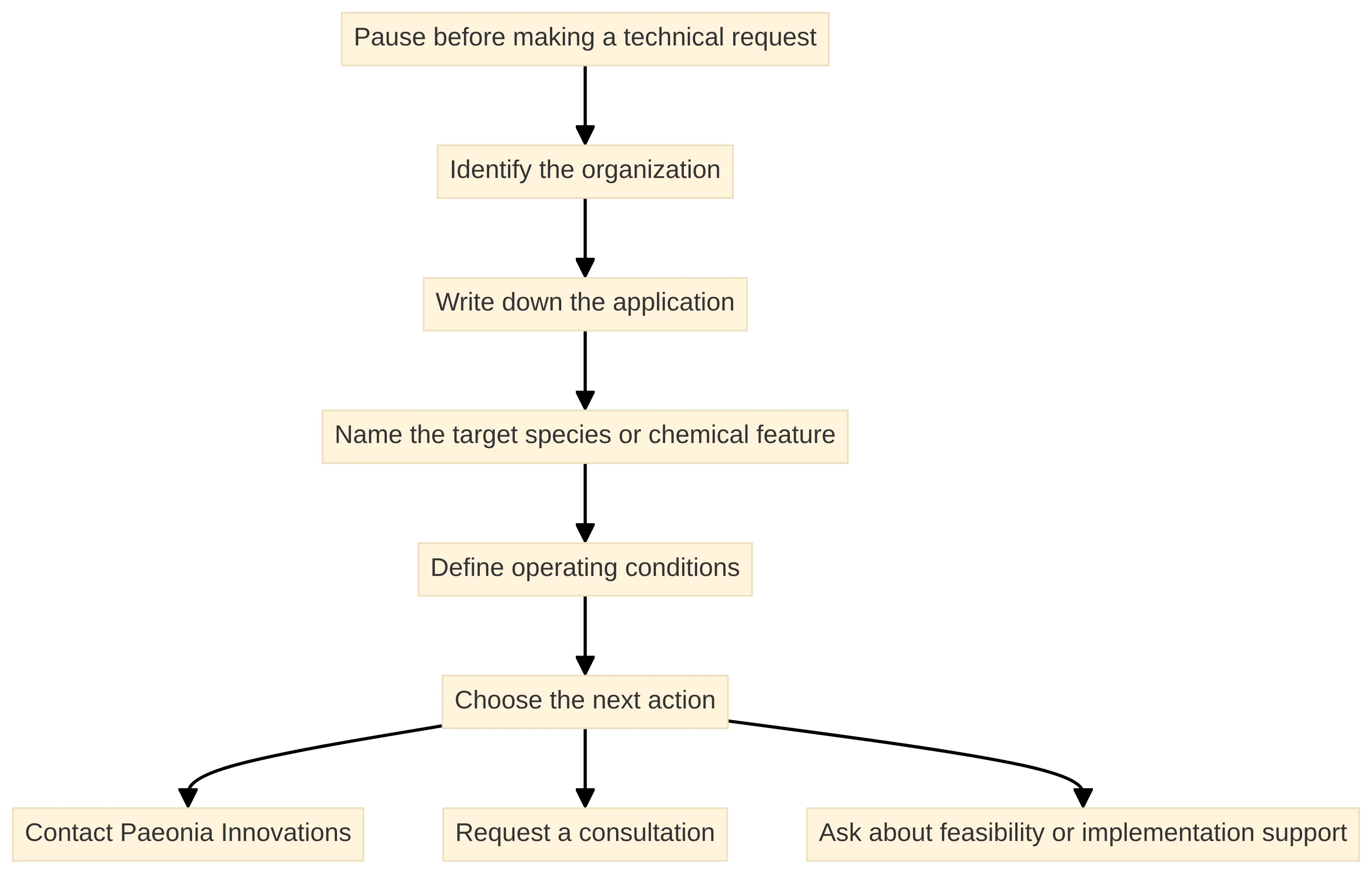
Contact Paeonia Innovations now when you can name the application, target species or chemical feature, expected concentration range, required accuracy, operating conditions, and integration setting. Include the reference method and its reproducibility if you are asking about sample testing. Send a requirements-led inquiry rather than a product-name query.
Request a consultation when the subject is clear but the measurement route is not. This applies when you know the chemistry or research objective but need to discuss measurement processes, sample presentation, or a possible partnership. We offer consultations for measurement processes, chemistry, and partnerships. Describe the open decision and the information already available.
Ask about feasibility or implementation support when integration is the main uncertainty. This applies to an OEM photonics system, a pilot arrangement, a reactor loop, or another defined interface where the technical route needs to be examined. We provide feasibility studies and implementation strategies for integration work. State the fixed constraints and the decisions the study must support.
Pause before making a technical request when you have only the term “paeonia.” The identity question is not enough to define a gas measurement, spectroscopy experiment, or integration problem. First identify the organization and write down the application, then contact the team with the missing requirements.
The inquiry is sufficiently defined for an initial technical discussion when it answers four practical questions:
- What are you trying to measure or observe?
- What material, gas mixture, or optical system will be presented to the measurement?
- Under what temperature, pressure, concentration, accuracy, and timing conditions must it operate?
- What decision should the discussion, sample test, feasibility study, or integration work inform?
You do not need to know every answer before asking a question. You do need to distinguish known values from unknown values. That boundary lets the team respond to the actual gap instead of guessing at your application.
The strongest initial inquiry is not necessarily the longest one. It is the one that identifies the decision, gives the conditions that govern it, and marks the remaining unknowns. A short brief with a defined application and clear limits is more useful than a long description that never identifies what must be established.
If your requirements are still broad, begin with the identity and application questions. If your requirements are specific but the route is uncertain, move to consultation. If the route and interface are defined but the evidence is incomplete, frame a feasibility or sample-testing question.
Send a requirements-led message to Paeonia Innovations
The search term identifies Paeonia Innovations in this context when the organization, technical subject, and official site align with your inquiry. Our stated portfolio connects OrionIR® with continuous chemical measurement, K2 Photonics dual-comb lasers with trace-gas and high-resolution absorption applications, and the OrionIR® Lab version with reactor-loop, pilot-rig, and bench arrangements. The relevant choice is not determined by the name alone. It depends on your species, matrix, concentration range, accuracy, temperature, pressure, reference method, sample setting, and integration objective.
Prepare those details before you make the inquiry. If a process sample or bounded feasibility discussion is appropriate, say what decision it should inform and keep the result boundary explicit. A qualified professional must decide individual technical suitability for your application, site, and operating conditions.
A requirements brief gives Paeonia Innovations a concrete basis for discussing your research or product-development question. Include the application, target species or chemical feature, measurement conditions, reference method, sample setting, and integration objective. State which values are known and which require discussion. The contact action is a message request, not a booked demonstration.
What should you confirm before relying on Paeonia Innovations for trace-gas work?
What is Paeonia Innovations and what do they specialize in?
Paeonia Innovations is a Singapore-based company that specializes in building compact chemical analysis instruments, particularly the OrionIR mid-infrared spectrometer and K2 Photonics dual-comb lasers, focusing on applications in trace gas detection, continuous chemical measurement, and photonics research.
How can I determine if Paeonia Innovations is relevant to my trace-gas detection needs?
To assess relevance, clarify your specific application, the gases or analytes of interest, concentration ranges, accuracy requirements, and the physical conditions of your measurement. This information will help you determine if Paeonia Innovations’ technologies align with your project.
What information should I prepare before contacting Paeonia Innovations?
Before reaching out, prepare details about your application, target gases, expected concentration ranges, required accuracy, temperature and pressure conditions, and any existing reference methods. This will facilitate a more productive discussion.
How does K2 Photonics dual-comb laser technology relate to trace-gas detection?
K2 Photonics dual-comb lasers are utilized for high-resolution absorption spectroscopy and trace-gas detection, providing the necessary resolution and broad coverage to identify multiple species in a single acquisition.
What should I consider regarding the physical measurement setting when discussing my project with Paeonia Innovations?
Consider the specifics of your measurement setting, including whether the sample is taken from a recirculation loop, pilot side stream, or bench setup, as well as the temperature, pressure, and composition of the sample.